What Is the Most Efficient Type of Irrigation System for a Titusville Yard?
The best system for your yard is usually a mix of two methods, each matched to the plants it waters.
What is the most efficient type of irrigation system?
Drip irrigation is the most efficient type of irrigation system. It delivers water slowly at the root zone through emitters or inline tubing, so very little is lost to wind, evaporation or runoff. Drip suits beds, hedges and trees. For turf, rotary nozzles on a zoned, sensor-controlled system are the efficient choice.
Why drip irrigation wastes the least water
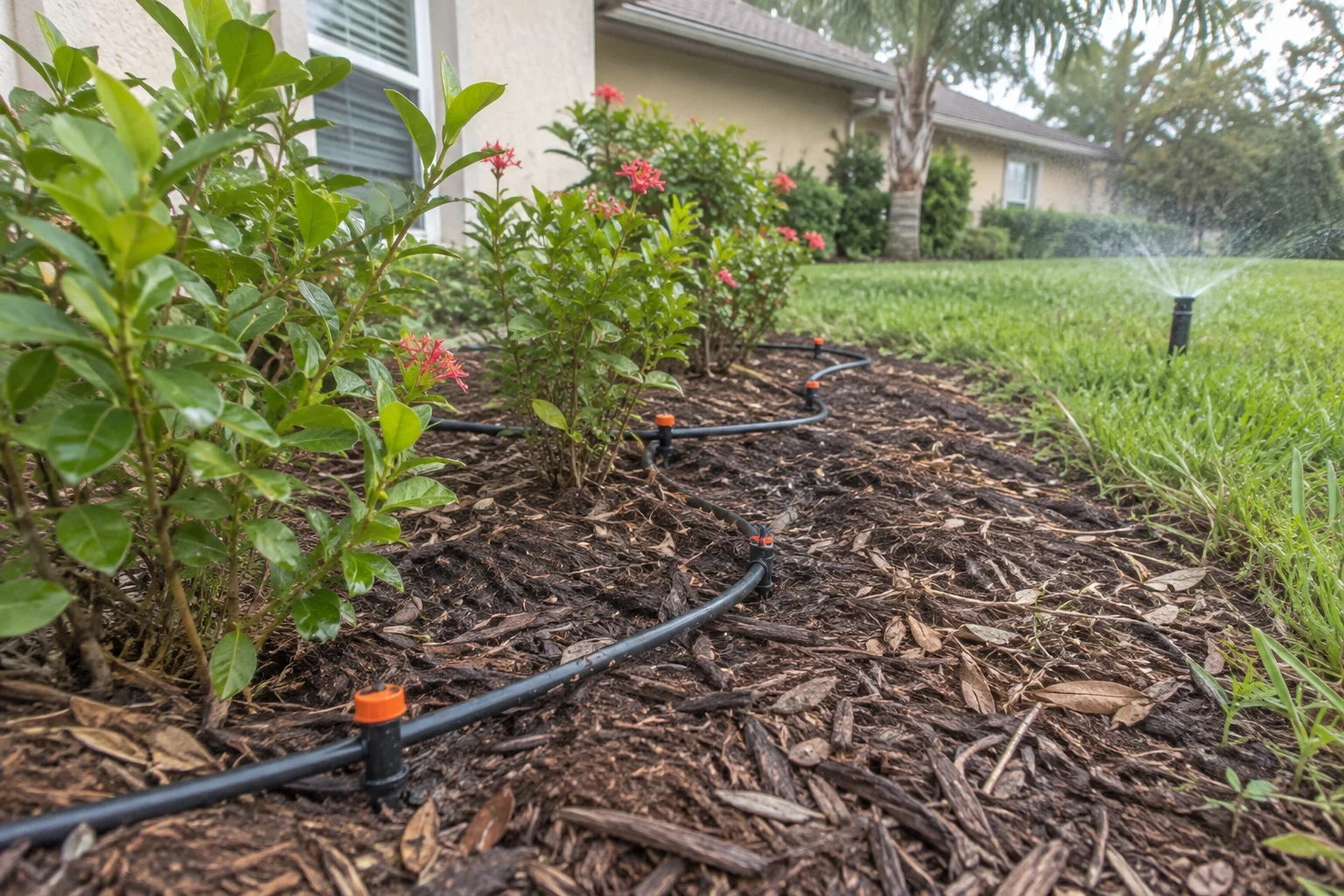
A drip system runs at low pressure, usually through a pressure regulator and filter at the zone valve, then into polyethylene tubing with emitters rated in gallons per hour. Water drips onto the soil instead of flying through the air, so wind drift and midday evaporation stop being factors. The leaves stay dry too, which cuts down on fungal leaf spot in shrubs.
Spray heads lose water in ways drip avoids: mist that blows away, overspray onto driveways and walls, and runoff when water lands faster than the soil can take it. On a typical bed zone, switching from spray heads to drip often lets you shorten run times because every drop lands where the roots are.
- Inline emitter tubing: emitters built into the line at set spacing, good for dense beds and hedge rows
- Point-source emitters: one or more per plant, good for spaced shrubs and young trees
- Bubblers: higher flow for establishing trees and large palms
- Micro-sprays: a middle ground for groundcover where tubing is hard to lay
Does drip work in sandy Florida soil?
It does, but it has to be laid out for sand. In heavier soil, water from an emitter spreads sideways into a wide wetted circle. In the fast-draining sand common around Titusville, it moves mostly straight down in a narrow column. That means emitters need to sit closer together, and inline tubing usually needs tighter spacing between rows, or the plants end up with dry pockets between wet spots.
We also place tubing under the mulch rather than on top of it. Mulch holds moisture near the surface and protects the tubing from sun, mower strings and foot traffic. If your beds need fresh mulch or new edging, it makes sense to plan that work alongside a drip conversion so the tubing goes in once and stays covered.
What is the most efficient way to water a lawn?
Drip is rarely the right answer for St. Augustine or Bahia turf. Subsurface drip under sod is possible, but in sand it tends to leave striped dry bands, and the lines get cut during aeration or repairs. For turf, the efficient choice is rotary nozzles or gear-driven rotors with matched precipitation rates.
Rotary nozzles, sometimes called multi-stream rotators, screw onto standard pop-up spray bodies and throw thick rotating streams instead of a fine fan of mist. They apply water more slowly, which gives sand time to absorb it and reduces runoff on slopes and near pavement. Large open areas are better served by rotors, which cover more distance per head.
Head-to-head coverage matters as much as the nozzle. Each head should throw water all the way to the next one. Gaps in coverage are why so many lawns get one brown patch that the homeowner tries to fix by running the whole zone longer, which overwaters everything else.
The parts that make any system efficient
The type of emitter or nozzle is only half of efficiency. How the system is divided and controlled decides how much water reaches plants that actually need it.
- Hydrozoning: turf, sunny beds and shaded beds on separate valves, because each needs a different run time
- Pressure regulation: spray heads misting at the nozzle are running too high; pressure-regulating stems or a regulator at the valve fix it
- Rain and soil sensors: Florida law requires a working shutoff device on automatic systems, and a functioning sensor skips cycles after summer storms
- Smart or weather-based controllers: they adjust run times to temperature and rainfall so the schedule is not set once and forgotten
- Check valves in low heads: they stop lines from draining out at the lowest head after each cycle
Planning an upgrade before the dry season
The hardest stretch for plants here is usually the dry, warm weeks of spring before the summer rains start. Watering is limited to assigned days under water management district rules, so a system that wastes water has less room to make up for it. Converting bed zones to drip and fitting rotary nozzles in the winter gives new plantings time to settle in before that stress arrives.
An upgrade does not have to happen all at once. Many homeowners start with the zones that waste the most, often narrow strips and beds watered by spray heads, and convert the rest over a season or two. We can walk your property, run each zone, and give you a written estimate broken out by zone so you can decide what to do now and what to plan for later. Financing with no prepayment penalties is available if you would rather do the full system in one pass.
More questions about efficient irrigation
- Can I convert my existing spray zones to drip?
- Usually, yes. A spray zone can be converted by capping most heads, adding a filter and pressure regulator, and running drip tubing from a riser, as long as that zone waters only beds and not turf.
- How often should drip lines be checked?
- A quick look a few times a year is enough for most yards. Flush the filter, check for tubing pulled up by rakes or animals, and look for emitters clogged by sand or mineral buildup.
- What time of day is most efficient for watering?
- Early morning, before sunrise, loses the least to evaporation and lets leaf blades dry as the day warms. Midday watering is restricted locally anyway, and evening watering keeps turf wet overnight, which invites fungus.
Find out where your system is wasting water
On a free on-site walkthrough we run each zone, check heads, pressure and the rain sensor, and explain which zones would gain the most from drip or rotary nozzles. You get a free estimate broken out so you can plan the work in stages.